
- 3 views
On August 2, India wrapped up the 2026 Commonwealth Games in Glasgow in fourth place with 39 medals. The medal tally, though, was only part of the story! India delivered its best-ever Commonwealth para-sports performance, with Indian boxers winning 10 medals, 7 of them gold, the most won by any nation in a single sport at the Games.
Like most of you, I watched some of it unfold and felt that unmistakable swell of pride at the grit on display. But what struck me most wasn't any single medal or athlete; it was the depth. Sustained performance rarely comes from one or two exceptional individuals; it comes from a system built to keep producing them. Behind Glasgow sat years of coordinated investment, athletes training abroad and preparing for the conditions they would face. That system did exactly what it was built to do—spot talent early and build enough depth that performance holds up even when individual circumstances don't.
A week later, another number caught my attention. No stadium this time, no medal ceremony, no cheering crowd, just a confirmation from the Ministry of New and Renewable Energy that India had crossed 300 GW of installed non-fossil electricity capacity. More than 54% of India's roughly 552 GW of installed electricity generation capacity is now non-fossil. India has already achieved more than 60% of its 500 GW non-fossil capacity target for 2030. It achieved a 50% non-fossil share of cumulative installed power capacity in 2025, five years ahead of the 2030 target under India's Paris Agreement commitment.
Let’s sit with the underlying numbers for a moment. Solar capacity has risen from 2.8 GW in 2014 to nearly 165 GW today. Wind capacity has nearly tripled to more than 58 GW over the same period. The domestic manufacturing ecosystem is also evolving. The capacity of solar PV models and manufacturers under the government's approved-list framework has risen from just 2.3 GW in 2014 to more than 200 GW.
On installed renewable capacity, India now ranks third in the world, behind only China and the United States, according to Renewable Energy Statistics 2026.
Why this matters
The 300 GW milestone matters beyond the headline number. India remains the world's fastest-growing major economy, but the engine underneath it is still structurally dependent on imported hydrocarbons. We import roughly 90% of our crude oil and 47% of our natural gas. That exposure shows in current account pressure, currency volatility and inflation that arrives via the exchange rate rather than the harvest.
That exposure is also concentrated at a single chokepoint. The Strait of Hormuz carries half our crude imports, 55–60% of our LNG imports and nearly 90% of our LPG imports. Any geopolitical friction in that corridor can send a shock through domestic supply chains, from freight to fertiliser. Energy security is more than an environmental or a strategic issue. It is a macroeconomic issue.
Building the Resilience Stack
This is precisely the vulnerability India has been working to address through a multi-layered ‘Resilience Stack’, designed to strengthen energy security, reduce exposure to external shocks and ensure that no single source, corridor or technology becomes a point of systemic weakness.
Each layer of the Resilience Stack targets a different point of exposure:
-
Storage: Strategic petroleum reserves now provide roughly 77 days of cover alongside industry stocks, with a further phase targeting 20–25 days of dedicated strategic reserves by FY31, in line with international benchmarks.
-
Sourcing: Crude procurement has diversified well beyond the Gulf, while long-term LNG contracts have reduced exposure to volatile spot markets.
-
Infrastructure: Alternative energy corridors are being considered to reduce dependence on individual shipping routes. A proposed undersea gas pipeline connecting Oman/UAE with Gujarat would bypass the Strait of Hormuz.
-
Technology: The National Green Hydrogen Mission, SHANTI Act and Nuclear Energy Mission, alongside battery storage, renewables and biofuels, are broadening India’s energy options.
The technology push is widening too. In his address on India’s 80th Independence Day, the Prime Minister called energy security a top priority. He announced plans for five new nuclear reactors this decade and a long-term target of 100 GW of nuclear capacity by 2047, more than 10 times today's base, under the SHANTI Act, 2025.
Together, these initiatives represent something larger than a conventional energy transition. They are attempts to build greater choice and resilience into the system.
Capacity isn't output
There is an important distinction between capacity and output. Installing a solar panel does not mean electricity is available every hour of the day. The real test is how effectively we can integrate that capacity into the grid.
A recent Bloomberg report noted that renewables accounted for close to 19% of India's electricity production in the quarter through June—a record share—even as a summer heatwave pushed peak power demand to new highs. Coal still accounted for roughly 70% of generation over the same period.
This reflects the reality that India's electricity demand is growing rapidly, with renewable generation being added alongside a still-large thermal base. The important point is that renewables are increasingly meeting a greater share of growing demand.
The challenge is shifting from simply adding renewable capacity to integrating it: building the transmission, storage and grid flexibility needed to make that capacity dependable. Estimates suggest that around USD 25–30 billion of additional investment could be required in transmission, storage and grid modernisation as renewable deployment accelerates. Battery Energy Storage Systems (BESS) can help manage peak demand, reduce reliance on thermal generation and carry a bigger share of the load around the clock, not just when the sun is out. India's cumulative BESS capacity crossed 1 GWh in 2025, with a significant growth pipeline supported by policy and renewable procurement requirements.
The transition, therefore, is not a binary switch from coal to renewables.
What this means for India
India will remain a net energy importer for some time yet. The objective is not to eliminate external dependence, but to make the economy progressively less vulnerable to it. The country's projections point to a structural easing of exposure: oil import dependence is projected to fall from roughly 87% to 57% by 2047, even as total energy demand keeps climbing with the economy.
And perhaps that is where the two scoreboards come together.
Much as Glasgow was a staging post on the road to Amdavad 2030, 300 GW is a staging post on the road to 500 GW — not the finish line, but evidence that the system is working.

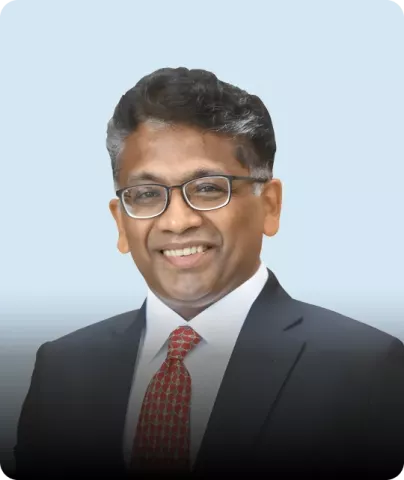
Mr. Vetri Subramaniam is the Managing Director and Chief Executive Officer at UTI Asset Management Company Ltd. He joined UTI AMC as Head of Equity in January 2017 and assumed the role of Chief Investment Officer from August 2021. Mr. Vetri has over three decades of work experience. Prior to joining UTI in January 2017, he was Chief Investment Officer at Invesco Asset Management Ltd. He was part of the start-up team at Invesco (then Religare Asset Management) in 2008 and helped establish the firm’s proprietary investment process and the team. Mr. Vetri started his career at Kotak Mahindra in 1992 after passing out from IIM Bangalore with a PG Diploma in Management. His experience in equity markets & investment roles at various firms from 1994 includes Kotak Mahindra, SSKI & Motilal Oswal. He was also one of the founders of Sharekhan.com (now Mirae Asset Sharekhan) where he led the research & content team. He has also worked as an advisor to a UK Hedge Fund Boyer Allan on its equity investments in India during 2003-2007. He is a frequent contributor to the media and regularly speaks on investing and markets at various forums - including the media & educational institutions.
Sonal Mittal, Senior Vice President – Products, co-authored this note.
Sources: Ministry of Petroleum and Natural Gas, Ministry of New and Renewable Energy, Ministry of Power, NITI Aayog Reports, Press Information Bureau, Central Electricity Authority