
- 3 views
The Indian markets are trading weaker following the outbreak of hostilities in the Persian Gulf. This is a continuation of the subdued trend that has persisted since early 2024. The Nifty has fallen 6.65% (in USD terms) over the two-year period from April 2024 to April 2026. During the same period, the S&P 500 delivered a return of 43.16%, while the MSCI EM Index posted returns of 52.99%. Importantly, both these indices are denominated in US dollars.
Many reasons are being offered for this weak performance, both in the media and by market pundits. I am often described as a market guru, though I always clarify that I remain a student of the markets, not a guru.
As a student I thought it worthwhile to examine whether the facts support these narratives and whether there may also be counterfactuals to some of them.
Narrative: Markets such as Korea and Taiwan are outperforming because they are beneficiaries of the AI-led spending boom. India, meanwhile, is suffering because it is not participating meaningfully in the AI spending cycle.
Analysis: It is true that markets such as Korea and Taiwan are benefiting from a surge in earnings driven by the AI spending cycle. Samsung Electronics, for instance, is estimated to earn US$229 billion in CY27, up from US$29 billion in CY25. That is not a typo.
In fact, the combined profits of Samsung Electronics and SK Hynix in Korea, along with TSMC in Taiwan, are expected to exceed the combined profits of Apple, Alphabet and Amazon next year. The sellers of picks and axes to the Mag 7 are making more money than many of those trying to build LLMs and associated intellectual property.
The KOSPI Index in Korea has posted a 149% return (in USD terms) over the 12-month period ended April 30, 2026. The TAIEX in Taiwan has delivered a 94% return (in USD terms) over the same period.
What is also true is that India has limited exposure, if any, to the AI spending cycle. In fact, India is increasingly being viewed as a potential loser because of risks AI could pose to the IT and business services sectors.
However, the counterfactual is that several markets, with little or no significant AI exposure, have also performed strongly over the same period. For example, Brazil’s Bovespa, Greece’s ASE and Poland’s WIG20 are up 58%, 33% and 32% respectively, despite having few, if any, AI-driven businesses.
Narrative: The Nifty 50 India is an old-world index dominated by financials, which is why it is underperforming.
Analysis: This is partly correct. The weight of financials in the Nifty 50 is 35%. Financials account for five of the top 10 stocks in the index as of April 2026.
However, this characteristic is not unique to India. In Brazil, 5 of the top 10 largest stocks are financials, while two are from oil & gas/mining sectors. In Poland, 6 of the top 10 are financials and two are from oil & gas/mining sectors. In Greece, four of the top 10 stocks are financials, two are utilities and one is an oil & gas company. These too are largely old-world industries.
So while the narrative is true for India, the counterfactual is equally important: several global markets dominated by financials and traditional sectors have nevertheless performed well.
Narrative: Foreign investors are selling in India and buying into markets benefiting from the AI spending cycle.
Analysis: This narrative is correct only as regards India. FPIs have sold equities worth US$30.6 billion in the 12 months ended May 12, 2026.
However, note that foreign investors have sold nearly US$40 billion worth of stock in Korea over the same period, while Taiwan has also witnessed net foreign selling of US$1.2 billion. So much for the narrative that foreign money is rotating into AI driven markets.
Domestic investors have been the primary buyers in both India and Korea. The price outcomes are different, but foreigners have been net sellers in both markets.
Narrative: Oil producers have done well after the geopolitical conflict, while oil importers have suffered.
Analysis: India, a significant net importer of oil and energy, has underperformed sharply since the outbreak of hostilities in the Persian Gulf. The Indian market is down 11.5% in USD terms between February 28 and May 13, 2026.
On the other hand, Vietnam has remained broadly flat since the outbreak, while Japan is up 6.3% over the same period — both in USD. Both countries are also net importers of energy, and the weight of the energy sector in their benchmark indices is relatively insignificant. Clearly, not all oil importers have underperformed.
Narrative: India has underperformed EMs by a record margin over the past 12 months and is now underweight in global EM funds.
Analysis: This is correct. India’s relative performance versus EMs over a rolling 12-month period, at -54%, is the weakest in the past decade (according to Axis Capital).
India’s weight in global EM funds (based on 70 EM funds with AUM of US$320 billion) is now 0.4% underweight versus the benchmark. The 10-year average positioning has been a 2% overweight, while 61% of the funds are currently underweight in India (Source: Jefferies Research).
Conclusion
What should one make of the narratives above? As investors, we must always look for data that either confirms or refutes a narrative. Equally important is the search for the counterfactual.
That is an essential part of the due diligence required in the investment process. Investment decisions should be anchored in financial goals, asset allocation targets, diversification to manage risk and valuations.
In other words, decisions should be driven by a disciplined investment process, not by narratives.
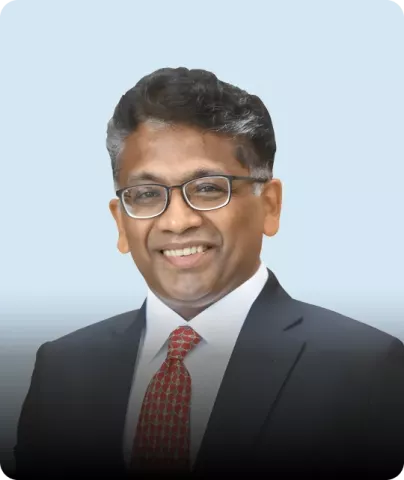
Vetri Subramaniam is the MD & CEO Designate at UTI Asset Management Company Limited. He holds a B.Com degree from University of Madras and a Post Graduate Diploma in Management from Indian Institute of Management, Bangalore. He joined UTI AMC as Head of Equity in January 2017, was elevated to Chief Investment Officer in August 2021 and has taken on the role of MD & CEO Designate. Prior to UTI, he held leadership and investment roles at Invesco Asset Management Private Limited, Motilal Oswal Securities Limited, Kotak Mahindra Asset Management Company Limited, SSKI Investor Service Private Limited and Kotak Mahindra Finance Limited.