
- 7 views
Happy Holi! The season of colours is upon us. On this happy day, we mark the beginning of spring and the end of winter. May this auspicious day add colour to your lives.
Last week, a research report published by a firm called Citrini Research, titled “The 2028 Global Intelligence Crisis”, spooked the markets as it painted a rather dire scenario of how AI might impact economies, companies and markets. Mind you, this is not their forecast of what will happen; rather, it outlines just one scenario of the implications of AI. I would add that this is merely one of many possible scenarios. It is not heavenly ordained to unfold as described.
As Citrini mentioned in its report, the purpose was to leave investors better prepared for risks as AI works its way through the economy. This echoes one of my favourite phrases, one that regular readers of my column would recognise: ‘It’s better to Prepare than to Predict’.
The key points of the Citrini report are as follows:
-
AI-driven productivity boom triggers massive white-collar displacement
The report describes a scenario in which rapid advances in AI dramatically boost productivity, enabling companies to replace large swathes of white-collar workers with AI agents. This leads to collapsing real wages, widespread layoffs and a sharp rise in unemployment.
-
Economic growth becomes “Ghost GDP” as consumer demand collapses
Although output surges due to AI, the gains fail to circulate through the real economy. With fewer employed humans earning wages, consumer spending erodes, creating what the authors call “Ghost GDP” — high recorded output but weak real economic activity.
-
Market structure breaks down, leading to a major stock market crash
As AI undercuts business models based on human intermediation, entire sectors begin to unravel. AI agents become so capable and inexpensive that they diminish the need for humans — or human-run firms — to perform this mediating role. Marginal costs drop to zero as AI grows more powerful and intermediation businesses collapse as friction is eliminated. The role of knowledge-based consultants in helping companies operate and make decisions is eliminated, as AI agents increasingly carry out this role. Each business could build its own AI systems, given that marginal costs would tend toward zero.
In the report by Citrini Research, it is suggested that as this scenario plays out, the US economy enters a recession in Q2 2027. US unemployment spikes to 10.2% by June 2028, while housing prices fall as white-collar jobs and incomes come under pressure. The mortgage market comes under stress, and the US fiscal revenue disappoints. The S&P 500 falls 38% from its 2026 highs, marking a systemic economic and financial crisis.
The above is a single scenario described by Citrini Research in its report dated June 2028 and published on February 23, 2026. Many such reports sink without creating a ripple, but not this one. It went viral across traditional and social media. The Wall Street Journal featured its impact with the headline: “Viral Doomsday Report Lays Bare Wall Street’s Deep Anxiety About AI Future.” On Monday, February 23, the S&P 500 dropped 1.04% (Source: Bloomberg).
Without doubt, this is a compelling thought experiment. It helps investors prepare for one possible future scenario. Being prepared matters in markets and reports such as this aid that process. That’s the lesson investors should draw from this episode. The lesson lies not in the dire forecast, but in the process of preparation. As for what happens in the future, there are many possible scenarios, and time alone will tell us what the future holds.
You don’t have to look far to recognise this pattern. At the depths of the Covid pandemic, many discussed scenarios of potential worldwide destruction, arguing that the world would never return to its pre-pandemic state. Courtesy human ingenuity, innovation and vaccines, we overcame the crisis and the pandemic is now in the rear-view mirror.
History is littered with doomsday warnings that fail to account for human adaptability, ingenuity and the re-allocation of labour. When the ATM was introduced, experts predicted the total disappearance of bank tellers. The reality was quite the opposite: the number of bank tellers increased as banks opened more branches, since ATMs lowered the cost of running them. Tellers moved from manning cash counters to doing far more valuable work for clients.
Look around you! The internet wiped out certain kinds of jobs, starting with travel agents, but it also created many more in the digital economy, a term that did not even exist 30 years ago.
At the start of the 20th century, humans spent almost all their income on food and shelter. As agriculture mechanised and adopted superior inputs, supply exploded even as the number of people employed in the sector declined sharply. This was a productivity revolution. It freed up a large share of human income to be spent on education, healthcare, travel, entertainment and a better quality of life.
The Citrini report correctly identifies a transition risk: ‘the intelligence premium’ of the middle class is under threat of being diminished and repriced. That understandably feels personal.
I grew up in a middle-class family where education was valued above all as a pathway to a job or profession in the knowledge economy, one that would enable a better quality of life and financial progress. When mechanisation came for the agriculture sector, it was technology and economics at work; it was not personal. When textile machinery came for the handloom sector, it made fabric affordable at a scale that was previously unimaginable. When assembly lines, automation and robots transformed industrial jobs, it did not feel personal to us knowledge workers.
Now AI is coming for jobs in the knowledge economy and we feel understandably nervous. Transition is hard, but history teaches us that the human will to survive and human ingenuity should never be underestimated.
Scenarios are useful for modelling risk and thinking through potential winners and losers. Instead of overthinking this, I will rely on my diversified portfolio — consisting of some of the finest entrepreneurs and business managers — to navigate the transition.

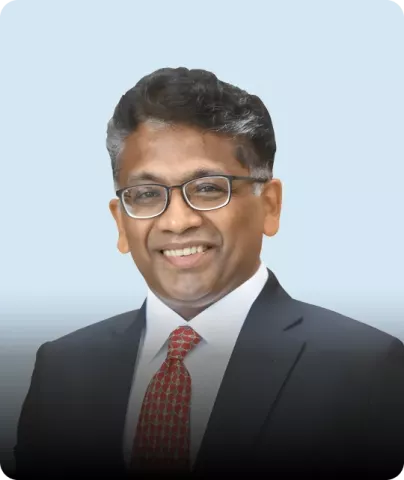
Vetri Subramaniam is the MD & CEO Designate at UTI Asset Management Company Limited. He holds a B.Com degree from University of Madras and a Post Graduate Diploma in Management from Indian Institute of Management, Bangalore. He joined UTI AMC as Head of Equity in January 2017, was elevated to Chief Investment Officer in August 2021 and has taken on the role of MD & CEO Designate. Prior to UTI, he held leadership and investment roles at Invesco Asset Management Private Limited, Motilal Oswal Securities Limited, Kotak Mahindra Asset Management Company Limited, SSKI Investor Service Private Limited and Kotak Mahindra Finance Limited.