
- 4 views
“Data is like garbage. You’d better know what you are going to do with it before you collect it.”
(Source: Unknown)
To make sense of numbers, we need the context and narrative that stitches the numbers together.
In September 2024, as per a statement at the GST meet, we were informed that tax revenue from online gaming had increased 412%, reaching ₹6,909 crore in six months.
A report by venture capital firm Lumikai, in the same year, stated that India's gaming market is expected to reach USD 9.2 billion by 2028-29, driven by a rise in advertisement revenue and in-app purchases.
India is now the world's second-largest market for mobile gaming downloads, 3.5 times larger than the US and Brazil, the report said, adding, “Average weekly time spent on games increased by 30 per cent, from 10 hours to 13 hours.”
The annual average revenue per paying user (ARPPU) increased by 15% to USD 22 in FY24 over FY23. With 25% of users making in-game payments, the number of paid gamers increased to 14.8 crore.
In August 2025, as India moved to ban real money gaming, Union Minister for Electronics and Information Technology Ashwini Vaishnaw spoke in the Rajya Sabha. He said that according to an estimate, 45 crore people are negatively affected by online money games.
Elaborating further, V. Anantha Nageswaran, Chief Economic Advisor to the Government of India, penned a column in which he said consumer spending on the gaming segment touched nearly ₹10,000 crore in July 2025 alone. This was based on NPCI (National Payments Corporation of India) payment data.
Nageswaran pointed out that this monthly figure translates into an annualised run rate of about ₹1.2 lakh crore, underscoring how deeply online gaming had woven itself into the country. He also noted that in 2023-24, 43% of the gamers were first-time wage earners aged 18-30 and that 44% of all gamers were women.
The FICC EY report Shape the Future for 2024 estimated that 11 crore people are now playing games daily, while 15.5 crore are engaged with real money gaming.
Nageswaran rightly said that something needed to be done to secure our demographic dividend, which led to the ban on real money gaming.
In September 2024, a study by the Securities and Exchange Board of India (SEBI), revealed that more than 9 out of 10 individual traders in the equity Futures and Options (F&O) segment incurred significant losses. The aggregate losses of individual traders exceeded ₹1.8 lakh crores over the three-year period between FY22 and FY24.
Between FY22 and FY24, 93% of over one crore individual F&O traders incurred average losses of around ₹2 lakh each, including transaction costs.
In contrast to individual traders, proprietary traders and Foreign Portfolio Investors (FPIs) booked gross trading profits of ₹33,000 crore and ₹28,000 crore, respectively, in FY24 (before accounting for transaction costs). Individuals and others incurred a loss of over ₹61,000 crore in FY24 (before accounting for transaction costs).
The proportion of young traders (below 30 years) in the F&O segment rose from 31% in FY23 to 43% in FY24. Individuals from Beyond Top 30 (B30) cities made up over 72% of the total F&O trader base, a higher proportion compared to Mutual Fund investors, 62% of whom are from B30 cities
It is at this juncture that one begins to ponder the state of affairs:
-
81 crore receive free food ration
-
48.8 crore gamers
-
15.5 crore paying gamers
-
13 hours average time per week spent on gaming
-
₹1.2 lakh crore p.a. estimated spend (bets) on gaming
-
1 crore individual F&O traders, of which 93% lost an average of ₹2 lakh p.a.
-
₹1.8 lakh crore aggregate losses in FY 22-24
Worried about the future of India? Hold your horses (no pun intended), I have more numbers to share with you.
Real GDP is estimated to grow by 7.8% in Q1 of FY 2025-26 compared to the growth rate of 6.5% during Q1 of FY 2024-25.
The Consumer Price Index (CPI)-based year-on-year inflation rate stood at 1.55% in July 2025, compared with July 2024. Headline inflation fell by 55 basis points in July 2025 compared with the previous month. This marks the lowest year-on-year inflation since June 2017.
S&P Global Ratings, on August 14, 2025, upgraded India's long-term sovereign credit rating to 'BBB' from 'BBB-'. The first upgrade in 18 years was done citing strong economic growth, improved monetary policy credibility and sustained fiscal consolidation.
According to S&P, the upgrade reflects India’s buoyant economic growth, against the backdrop of an enhanced monetary policy environment that anchors inflationary expectations.
Our strong macroeconomic platform enabled the Centre to cut and simplify the GST rates this month. As per government estimates, this would result in tax foregone by the Centre to the tune of ₹48000 crore. This will now remain in the hands of consumers, to spend as they choose.
Most people get disoriented when confronted with numbers running into thousands, lakhs or crores. I agree, it can feel intimidating. Let me help you think of such large numbers in a simpler format.
A useful way is to compare the number to the size of the GDP, which is nothing but our national income for the year. For example, let’s say Indians spend ₹1 lakh crore on a particular market segment. Compare that amount to India’s annual income of ₹350 lakh crore, and suddenly, we are looking at just 0.3% of our GDP.
Another trick is to look for the opposite!
The April 2025 Forbes Billionaires List mentions the names of 3028 billionaires worldwide, of which 205 are in India.
That figure coexists with the 80 crore people entitled to free foodgrain.
India, by the numbers, can be confusing. Which is why it is vital to understand the context and narrative behind every number.
Sources: Bloomberg, CSO, MoSPI, SEBI

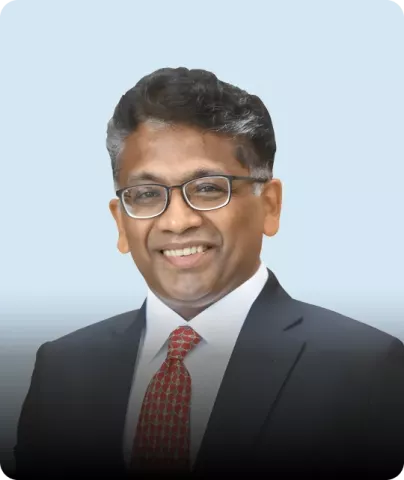
Vetri Subramaniam is the MD & CEO Designate at UTI Asset Management Company Limited. He holds a B.Com degree from University of Madras and a Post Graduate Diploma in Management from Indian Institute of Management, Bangalore. He joined UTI AMC as Head of Equity in January 2017, was elevated to Chief Investment Officer in August 2021 and has taken on the role of MD & CEO Designate. Prior to UTI, he held leadership and investment roles at Invesco Asset Management Private Limited, Motilal Oswal Securities Limited, Kotak Mahindra Asset Management Company Limited, SSKI Investor Service Private Limited and Kotak Mahindra Finance Limited.