
- 1 view
Bollywood aficionados may remember Deewaar (the 1970’s blockbuster) as the story of two brothers who take very different paths: one choosing the more disciplined road, the other accumulating enormous wealth but making choices whose consequences eventually begin to show. The evolution of India and the US over the past decade offers an interesting parallel.
A decade ago, an Indian debt issuer—whether the Government, corporate or a household—paid a substantial interest-rate premium over an American one. There was an intuitive logic to it. As an emerging economy, India had to compensate investors for inflation, currency and other macroeconomic risks. The US, as the world's largest advanced economy and issuer of the dominant reserve currency, could attract capital at substantially lower rates. That gap has narrowed dramatically over the past decade.
The chart below illustrates this change:
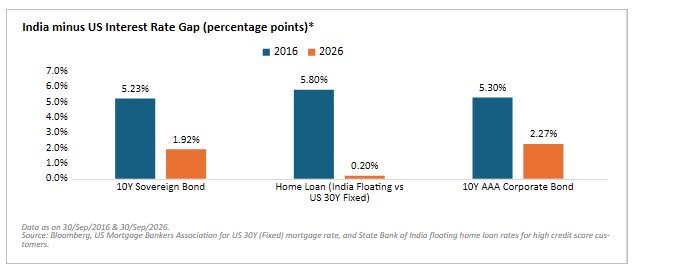
What does this mean for an actual borrower?
Consider a US homeowner taking a $100,000, 30-year mortgage. The monthly payment has risen from about $449 at 3.5% in 2016 to $686 at 7.3% today—a 53% increase. Compare this with an Indian homebuyer taking a ₹1 crore, 20-year loan: the EMI has fallen from roughly ₹91,900 at 9.3% to ₹80,600 at 7.5%-12% lower.
The corporate CFO sees something similar. At the AAA yields above, annual interest on $100 million of US borrowing rises from roughly $2.2 million to $5.7 million. In India, the comparable borrowing rate has barely changed. Reliance Industries recently raised ₹13,000 crore of 10-year money at a 7.90% coupon, remarkably close to where a top-quality Indian company could borrow a decade ago.
For governments, the contrast is even more striking. Every $100 of fresh 10-year US government borrowing costs about $5.30 annually today, versus $1.60 in 2016. In India, ₹100 of similar borrowing costs ₹7.20 versus ₹6.80. As older, low-cost US debt matures and is refinanced at today's rates, the rising interest bill absorbs money that could otherwise fund other priorities.
This raises some uncomfortable questions. Have Indian rates become too low? Does the narrowing differential mean Indian rates must eventually rise, or the currency adjust sharply downwards? Or is something more fundamental happening beneath the surface?
To answer that, we need to look at how the macroeconomic paths of these two economies have evolved.
What India got right?
The answer starts well before Covid.
India's experience around the taper tantrum in 2013 is worth recalling. A large current account deficit (imports far higher than exports) and elevated inflation made the economy particularly vulnerable to changes in global rates.
The external position today is considerably more comfortable. India's current account deficit (CAD) has become manageable, with average CAD declining to near 0.6% of GDP during FY24-FY26 vs 1.4% in FY14-FY16. This has been supported by the structural rise in services exports and remittances. Foreign exchange reserves provide a substantially larger buffer.
The second change has been the formal adoption of an inflation target in 2016, providing a clear anchor for monetary policy and a credible framework for managing inflationary shocks.
And the third important change came after Covid: fiscal consolidation.
The pandemic pushed the Central Government fiscal deficit to 9.2% of GDP in FY2020-21. But that exceptional fiscal expansion did not become permanent. The deficit has subsequently been brought down progressively to 4.4% over the following five years.
As these underlying fundamentals improved, India's macroeconomic risk premium has also declined.
The US took a different road
In 2016, the US enjoyed an extraordinary combination: low inflation, low policy rates and quantitative easing (where the central bank bought large quantities of government bonds). A 10-year Treasury yield below 2% and a 30-year mortgage below 4% were byproducts of that environment.
Unlike India, US fiscal deficits have remained unusually large even after the pandemic shock passed. The federal deficit currently remains around 6% of GDP, compared with an average of 3.6% during 2015-2019.
That has consequences. Large deficits mean heavy bond issuance at a time when the Federal Reserve is no longer buying government bonds on the scale it once did. Higher government debt, rising interest expenditure and increased bond supply mean investors could demand a higher premium for holding US debt.
Meanwhile, stronger US growth, including investment associated with the AI capex boom, may also mean the economy can sustain higher interest rates than in the previous decade.
Back to the puzzle
If the India-US interest-rate differential has compressed so dramatically, must Indian rates rise to restore the old relationship? Must the rupee weaken sharply to compensate investors?
Not necessarily.
The 500-basis-point-plus differentials during the previous decade reflected the macroeconomic circumstances of both countries. India carried a larger inflation and external-risk premium, while the US enjoyed an unusually low cost of capital.
Both sides of that equation have changed
None of this suggests that India and the US now carry equivalent risks. In the eyes of global investors India sits in the emerging economy basket and requires a higher risk premium due to currency risk, inflation differentials and differences in market depth. Indian yields and the rupee will continue to respond to domestic and global economic cycles.
But investors should also be careful about assuming that yesterday's spread represents some natural equilibrium to which markets must inevitably return.
The gap between Indian and US interest rates will expand and contract with economic cycles. If India preserves the gains made on inflation, fiscal discipline and external stability, there is no reason why that gap cannot remain structurally narrower than it was over the previous decade.


Mr. Vetri Subramaniam is the Managing Director and Chief Executive Officer at UTI Asset Management Company Ltd. He joined UTI AMC as Head of Equity in January 2017 and assumed the role of Chief Investment Officer from August 2021. Mr. Vetri has over three decades of work experience. Prior to joining UTI in January 2017, he was Chief Investment Officer at Invesco Asset Management Ltd. He was part of the start-up team at Invesco (then Religare Asset Management) in 2008 and helped establish the firm’s proprietary investment process and the team. Mr. Vetri started his career at Kotak Mahindra in 1992 after passing out from IIM Bangalore with a PG Diploma in Management. His experience in equity markets & investment roles at various firms from 1994 includes Kotak Mahindra, SSKI & Motilal Oswal. He was also one of the founders of Sharekhan.com (now Mirae Asset Sharekhan) where he led the research & content team. He has also worked as an advisor to a UK Hedge Fund Boyer Allan on its equity investments in India during 2003-2007. He is a frequent contributor to the media and regularly speaks on investing and markets at various forums - including the media & educational institutions.
Anurag Mittal, Head – Fixed Income, co-authored this note.
|
*Interest rates in India and US |
||
|
|
2016 |
2026 |
|
India 10Y Sovereign |
6.82% |
7.20% |
|
US 10Y Treasury |
1.59% |
5.28% |
|
India Home Loan (Floating) |
9.30% |
7.50% |
|
US 30Y Mortgage (Fixed) |
3.50% |
7.30% |
|
India 10Y AAA Corporate Bond |
7.49% |
7.92% |
|
US 10Y AAA Corporate Bond |
2.19% |
5.65% |