
- 8 views
Now that I have your attention with that clickbait headline, let’s get down to the truth!
To be honest, I don’t know what the biggest risk of 2026 could be. Just as I didn’t know for any year before this. Nor do I have a forecast for how the market might behave in 2026, as has been the case in every past year. I have been around in this market for long enough to recognise that forecasts can be useless. Every year, one forecaster on Dalal Street or BKC or Wall Street will get it right. But unfortunately, you don’t know who among the multitude of forecasters it will be.
During World War II, Nobel Laureate Kenneth Arrow was assigned to a team of statisticians tasked with producing long-range weather forecasts. After a time, Arrow and his team determined that their forecasts were not much better than pulling predictions out of a hat. They wrote their superiors, asking to be relieved of the duty. They received the following reply, and I quote: “The Commanding General is well aware that the forecasts are no good. However, he needs them for planning purposes.”
In other words, what matters is your plan and not your forecast.
Back to risks. The usual ones today are well known and discussed widely:
-
indifferent private capex
-
trade wars
-
fiscal and monetary policies
But to the extent that these are known risks, they are likely already reflected in the market. Unless I have a meaningfully different perception from the consensus and I am right about the outcome, these risks are probably already discounted by the market.
The biggest market-moving risks are typically those that were unexpected, not built into the consensus, or risks that nobody had ever imagined. The Pandemic caused by COVID-19 was something that nobody had imagined except perhaps Bill Gates and a few others. Even the GFC of 2008-2009 was a complete outlier, a true 6-sigma event for the markets because nobody expected the crisis to be so widespread and cataclysmic.
By the way, don’t think about risk as a one-way street. The only time I saw the market close in an upper circuit was in May 2009 when the UPA won an election with an improved majority and the markets were super excited by the outcome. Although those hopes were dashed over the next four years, it was a surprise that the markets closed higher by nearly 17% on that single day.
Let’s get back to the words of the commanding general (sent to Kenneth Arrow): it is better to have a plan than to have a forecast. With that in mind, consider how you could go about managing risk.
The first thing to note is that risk management is more like a mystery than a puzzle. In the words of Gregory Treverton, an American foreign policy and intelligence executive, in a jigsaw puzzle, all the pieces have a defined place and will fit only in that place and nowhere else. [The commentary was originally published by Smithsonian Magazine in 2007](RAND):
‘That is why millions of people try to solve crossword puzzles each day. The process can be frustrating, but there is satisfaction in knowing the right answer exists. Puzzles can be solved. A mystery offers no such comfort because the answer is contingent. You are dealing with the known and the unknown and their future interaction. A mystery cannot be answered; it can only be framed, by identifying the critical factors and applying some sense of how they have interacted in the past and might interact in the future. A mystery is an attempt to define ambiguities.’
Let’s take 2025 as an example. The US shocked the whole world with its announcements of reciprocal tariffs. The tariffs were expected to dent US economic growth and push inflation higher. However, this risk failed to materialise, with the US registering growth of 4.3% (SAAR) in the third quarter of 2025. One reason could be that the tariffs did not bite as much as initially expected. The Budget Lab at Yale estimates (Nov 2025) the effective tariff rate at 17%, much lower than the worst fears prevailing in the middle of the year. Courtesy of the AI boom, strength in tech capex (+18% yoy) contributed a third of the 2.3% yoy GDP growth (ING). What was expected early in the year did not happen, for a different set of reasons.
Diversification is an efficient strategy to tackle risk
In a hurricane, it is not the strongest but the most flexible tree that is best placed to weather the challenge. Much like this, diversification across asset classes, geographies, styles and market caps is meant to protect against the short-term volatility of individual asset classes. Those who wish to pursue a strategy of maximisation attempt to choose from the above menu to position themselves in the best-performing option, at every point in time. This is extremely difficult, if not impossible!
For most, the optimal choice is to diversify across asset classes, styles, geographies and market caps. This diversification provides the aggregate portfolio with the flexibility to tackle headwinds. Investors experienced this in 2025, when their small-cap portfolios underperformed large-cap portfolios or when several EMs and developed markets outperformed India and gold outperformed many equity markets.
All of this brings us back to the original point: if risk cannot be forecast, it has to be managed through planning. The biggest risk for 2026, therefore, is the same as it has been for every other year. Hence, your plan should be to stay diversified and provide your portfolio with the flexibility to absorb adverse headwinds, whether expected or not. Rinse and repeat, every year.
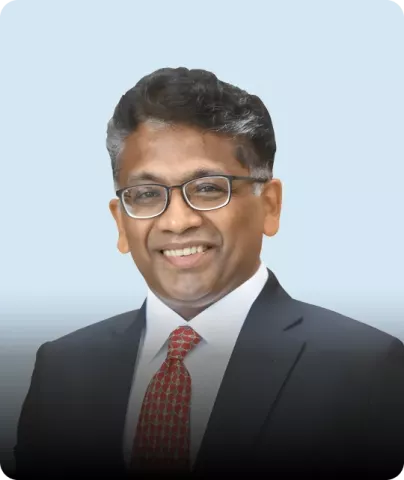
Vetri Subramaniam is the MD & CEO Designate at UTI Asset Management Company Limited. He holds a B.Com degree from University of Madras and a Post Graduate Diploma in Management from Indian Institute of Management, Bangalore. He joined UTI AMC as Head of Equity in January 2017, was elevated to Chief Investment Officer in August 2021 and has taken on the role of MD & CEO Designate. Prior to UTI, he held leadership and investment roles at Invesco Asset Management Private Limited, Motilal Oswal Securities Limited, Kotak Mahindra Asset Management Company Limited, SSKI Investor Service Private Limited and Kotak Mahindra Finance Limited.