- 15 views
Comments by Deepesh Agarwal
January 2026
The paradox of choice in Indian markets
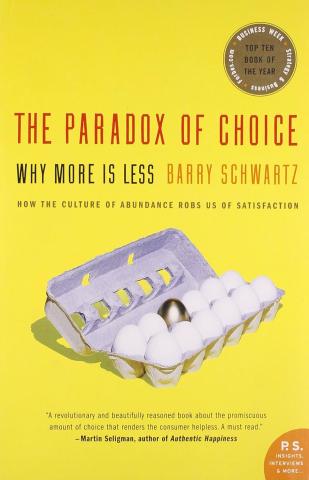
In his book ‘The Paradox of Choice: Why More is Less’, American psychologist Barry Schwartz argues that modern Western societies offer an unprecedented abundance of choices. These include consumer goods, careers, lifestyles, retirement planning and even personal relationships. Paradoxically, this surplus often leads to decreased happiness, increased anxiety, and decision-making paralysis.
Schwartz differentiates between “Maximizers,” who strive to make the absolute best choice by exhaustively evaluating all options, and “Satisficers,” who settle for a choice that is “good enough” based on their criteria.
The central paradox is that more freedom of choice, intuitively linked to greater welfare and autonomy, actually generates several negative consequences:
-
Decision Fatigue: The cognitive burden of evaluating numerous options depletes mental energy.
-
Rising Expectations: With so many options available, we expect a perfect choice to exist, making disappointment more likely.
-
Opportunity Costs: We fixate on the attractive features of the alternatives we reject, diminishing satisfaction with the option we select.
-
Regret and Self-Blame: When outcomes are imperfect, we blame our ability to choose wisely, leading to regret and reduced well-being.
-
Paralysis: The overwhelming array of choices can cause us to defer decisions or avoid them altogether.
Freedom vs. wellbeing
Schwartz’s solution is not to eliminate choice, but to manage it more consciously through the following practices:
-
setting meaningful constraints
-
adopting “satisficing” strategies
-
lowering expectations about the perfection of outcomes
-
making decisions non-reversible, where possible
-
practicing gratitude for the options we choose
-
curbing social comparison
Ultimately, he advocates focusing on what truly makes life meaningful—community, relationships, and personal development—rather than the endless pursuit of optimal selection.
Connection with equity markets
The Indian equity market offers a powerful, real-world manifestation of Schwartz’s paradox.
-
The overwhelming universe of options: For investors, there are approximately 6000 listed companies on the NSE and BSE across sectors. Of these, nearly 1800 companies are above ₹500 cr market cap (Source: Bloomberg), spanning varied sectors, growth profiles, RoCE and valuations. This explosion of choice is both empowering as well as paralysing.
-
The maximizer’s curse in portfolio construction: Such investors chase alpha through endless screening, often suffering from:
-
decision fatigue from Bloomberg marathons
-
FOMO on every IPO and OFS
-
post-buy regret ("Why not that multibagger?")
-
the endless review trap of tweaking holdings quarterly
A maximizer investor tries to maximize returns across every time horizon (year, month, week, or even day). This creates suboptimal outcomes over the long term.
-
The “satisficing” investor as the winner: The most successful long-term Indian equity investing philosophies align closely with Schwartz’s “satisficing” principle, as they follow:
-
Simple, rule-based frameworks (for example, economic moats)
-
Long-term orientation and gratitude (holding winners for decades and ignoring short-term noise)
A satisficing investor doesn’t compare returns with others and remains content if they exceed a certain threshold over longer periods.
Simplification: the ultimate edge
Schwartz's lesson cuts deep for Indian investors. In a market of infinite tickers and 24/7 hype, survival demands deliberate ignorance. Ditch the "click every IPO" frenzy in favour of a lean, conviction-driven portfolio. Wealth—and sanity—come not from sampling everything, but from mastering the art of saying no.
Key conclusion
As the book suggests, the secret to wealth (and mental peace) isn't having the most options; it’s having the discipline to ignore most of them. The paradox winner ignores 99% of options in order to own the 1% that truly matters.
Mutual Fund investments are subject to market risks, read all scheme related documents carefully.

Deepesh Agarwal is working with UTI AMC Ltd as Senior Associate Vice President (Equity) – Department of Fund Management since November 2017. In research he covers Engineering, Infrastructure, Utilities and Textile sector. Overall, he has 10.5 years of work experience with last 4.5 years at UTI preceded by 4 years stint at Ambit Capital as Equity Research Analyst and 2 years at Hexaware Technologies as Corporate Finance Executive